

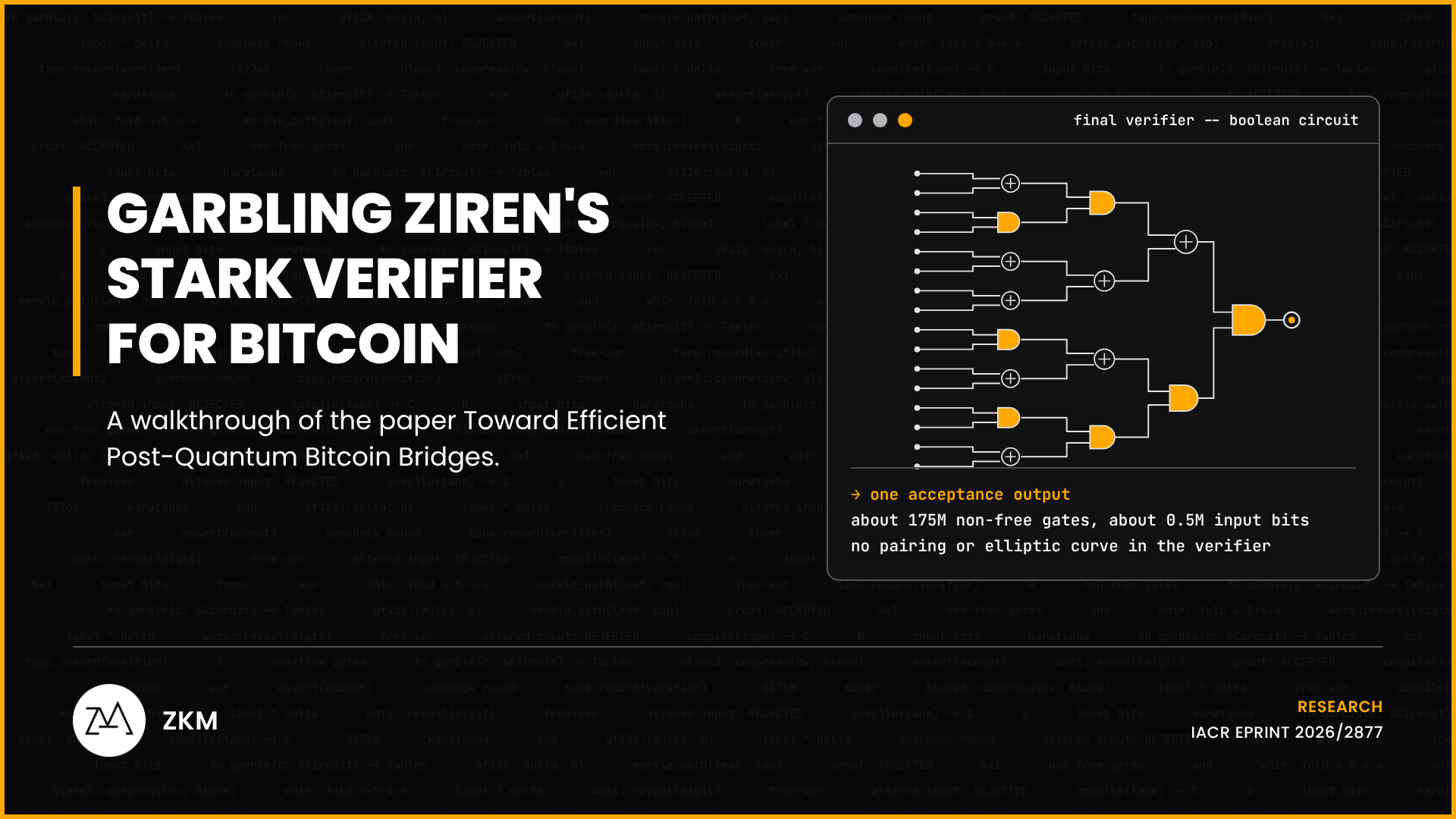
"Toward Efficient Post-Quantum Bitcoin Bridges" has been published on the IACR Cryptology ePrint Archive. It takes the complete verifier for the STARK proofs Ziren produces, compiles it into a Boolean circuit, and garbles it for a BitVM3-style dispute on Bitcoin. Nothing in that verifier rests on an elliptic curve or a pairing.
For the proof of Ethereum mainnet block 26,206,588, the final verifier has 175.4 million non-free gates and reads 520,832 input bits. Its garbled tables are 2.81 GB. Publishing its input on Bitcoin in a dispute takes 3.93 million virtual bytes in 41 standard transactions.
This post explains where those numbers come from, what they replace, and what the paper leaves unbuilt.
In September we set out a test for the phrase "post-quantum": every assumption in the security theorem has to hold against a quantum adversary, including the assumptions of whatever statement a hash-based layer carries. A garbled circuit is hash-based. A garbled Groth16 verifier still asserts a pairing equation, so it inherits the break.
That is where existing BitVM-style bridge designs stand. A STARK is large, so it is wrapped in a pairing-based SNARK and the SNARK's verifier is what gets garbled. Witness-encryption designs shrink the off-chain data further, to megabytes, and they are keyed to the same pairing relation.
On Ethereum, the way out is a verifier in Solidity that checks the hash-based proof directly, which The last two curves described on November 11th. On Bitcoin, a hash-based verifier written directly in Script does not fit: our September measurement put a WHIR opening alone at about 560 MB of script. The route that keeps the chain footprint to the proof itself is to garble the hash-based verifier. Garbling only requires that the verifier be a Boolean circuit. The questions are how large that circuit is and how much proof has to reach the chain.
Under free-XOR garbling, a circuit pays only for its non-linear gates. In a field of characteristic two, every addition is an XOR. A STARK over GF(2^128) with Blake3 commitments therefore costs, as a garbled circuit, its field multiplications and its hashes. Additions are free.
The paper implements Plonky3's binary tower arithmetic as Boolean gadgets with recursive Karatsuba multiplication, which gives 2,187 AND gates for a multiplication in GF(2^128). Squaring and multiplication by the tower generator use XORs only. It also rewrites the carry logic in the Blake3 circuit of GOAT's bitvm-gc, which halves a compression from 20,657 AND gates to 10,281.
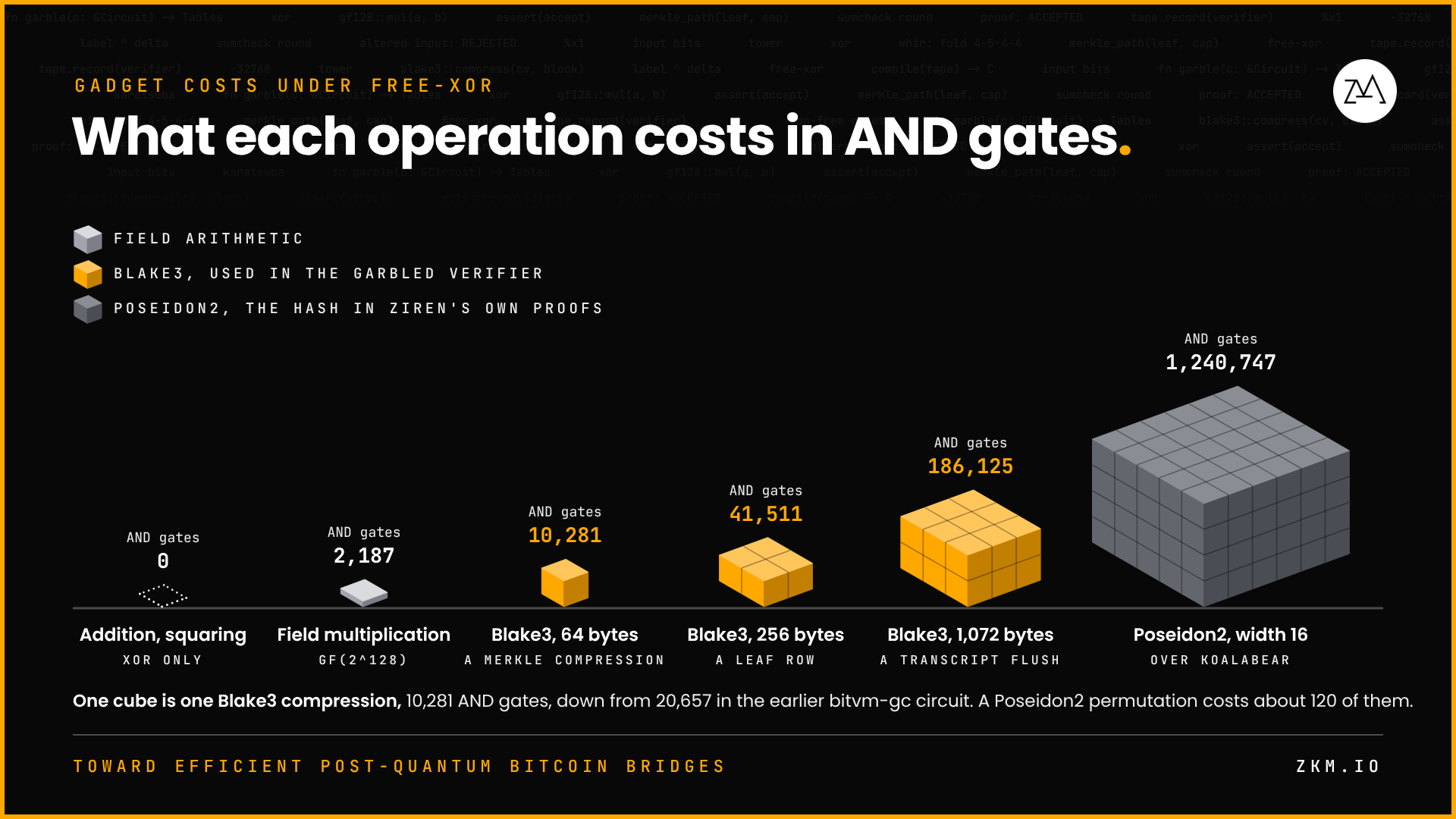
The hash matters more than the proof system. A width-16 Poseidon2 permutation over KoalaBear costs 1,240,747 AND gates as a Boolean circuit, about 120 Blake3 compressions. Ziren's own proofs are committed with Poseidon2 over KoalaBear, so they are the wrong thing to garble directly. Ziren's binary stage re-proves the verifier of the compressed proof in a binary-field system, and the circuit that is finally garbled contains no KoalaBear arithmetic.
Blake3 serves three roles: the Merkle commitments, the Fiat-Shamir transcript and the garbling hash. One hash keeps the verifier's assumptions to Blake3 modeled as a random oracle with circular correlation robustness.
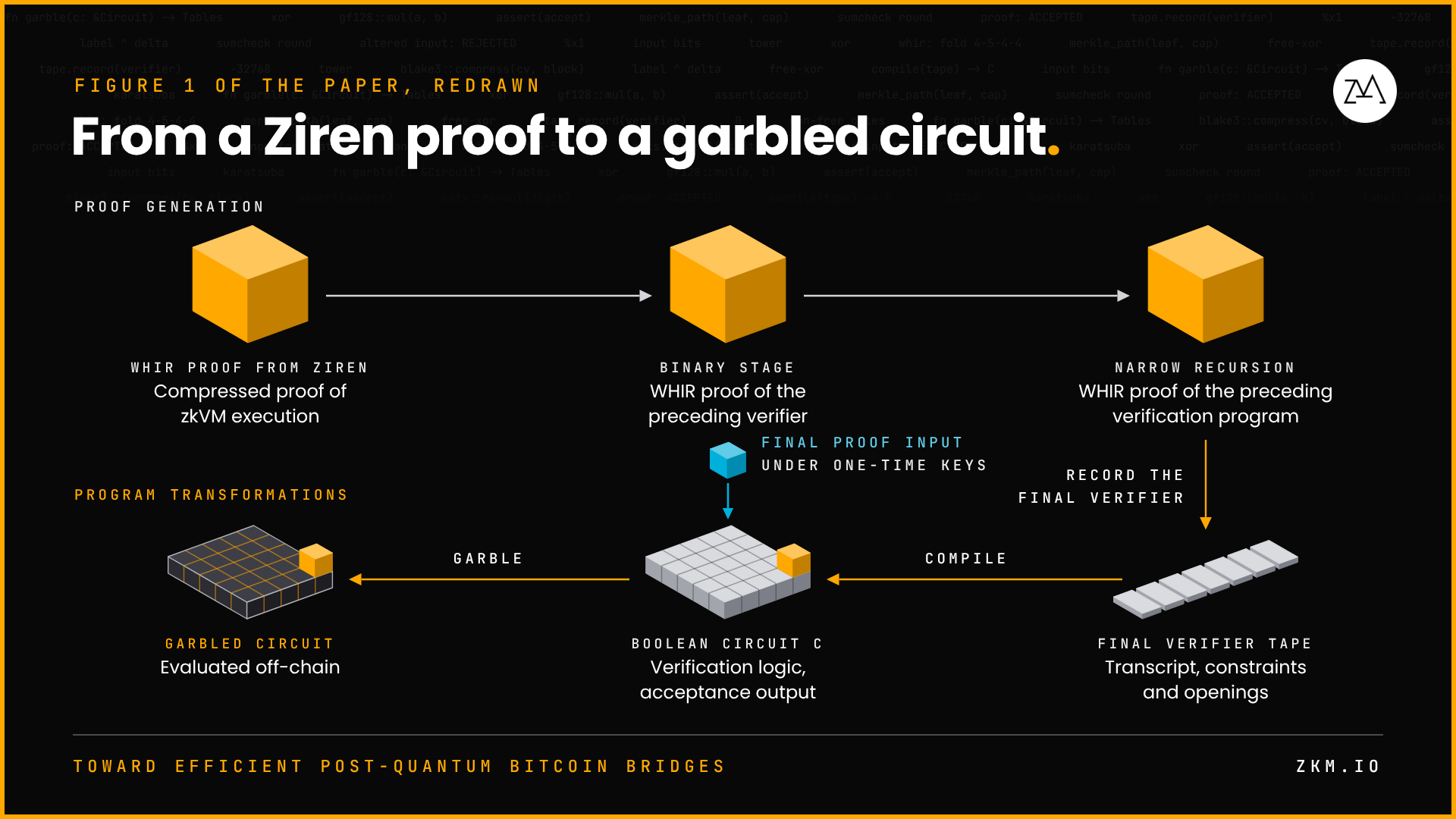
Ziren executes the block in 110.8 million cycles over 49 shards, proves the shards on GPU and compresses them into one proof. The binary stage proves the execution of that proof's verifier in a binary-field proof system. Four recursion proofs follow, each proving the execution of the previous proof's verifier. The first two use Ziren's plain recursion machine. The last two are narrow-recursion proofs, made in a machine with fewer trace columns, so that the final verifier has less to read.
A recorder then executes the verifier of the last proof once and writes out its straight-line program: field arithmetic and assertions, byte conversions, selections, Blake3 compressions and Merkle steps. The compiler turns that program into a Boolean circuit instruction by instruction and joins every assertion and range check into one acceptance output.
The compiled verifier was checked against the block's real final proof. It accepts that proof, rejects three single-input changes, agrees with the recorded execution on all 10,121,640 intermediate values, and garbles in 121 seconds on one core.
From block to final proof, the prover took 1,174 seconds of wall time on at most four RTX 5090 cards. Most of the last proof's time is proof-of-work grinding, which is the lever the paper uses to shorten the input.
In a BitVM3-style dispute the operator publishes the proof under one-time keys that hand the challenger the circuit's input labels. Every input bit therefore costs virtual bytes. A Groth16 proof is about a thousand bits. This verifier reads 520,832.
The paper serializes four ways of publishing that input and counts everything in the reveal transactions: selection witnesses, authentication scripts, control blocks, transaction-binding signatures and fixed fields.
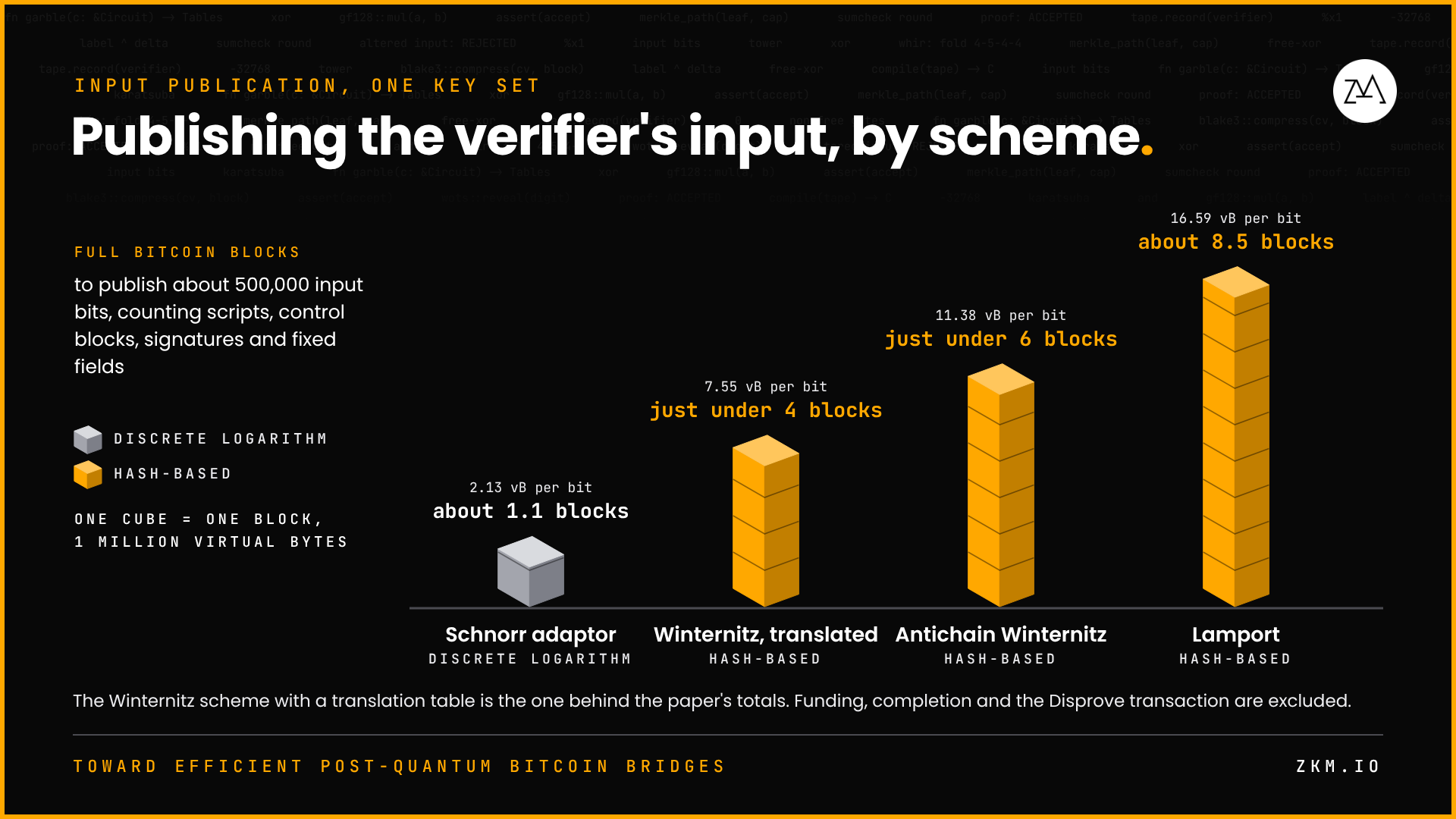
Schnorr adaptor signatures, as in BitVM3 and Mosaic, are the cheapest at 2.13 vB per bit, and they rest on discrete logarithms. Of the hash-based schemes, Winternitz keys with a translation table cost 7.55 vB per bit, Antichain Winternitz 11.38 and Lamport 16.59. For this input the translated Winternitz publication is 3.93 MvB in 41 transactions that each stay inside Bitcoin Core's standard relay limits. Confirming them takes one block for funding and at least four full blocks of reveals.
An unchallenged claim publishes none of this. It needs two transactions.
The paper also serializes a hash-based selector that would match the adaptor's size if Bitcoin had a batch hash-verification opcode, a hash-based transaction signature and the draft pay-to-Merkle-root output. None of the three exists on Bitcoin today, and the paper presents the result as a measurement of what such an opcode would be worth.
Onchain cost is linear in the input bits. Off-chain storage is linear in the gate count. Proving time grows exponentially with the grinding that shortens the input. Each reduction in the paper moves cost from one of these to another, and the paper states the exchange rate each time.
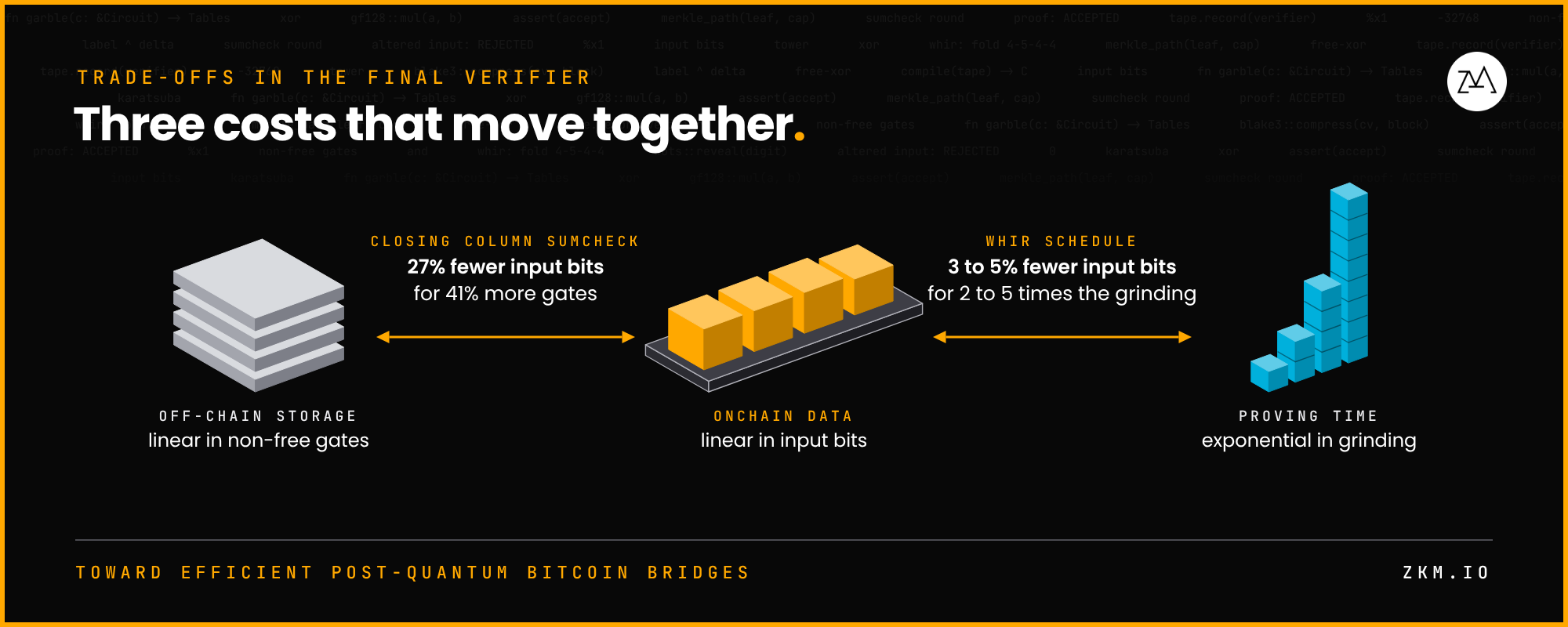
The closing column sumcheck sends 126 column folds in place of 1,744 opened values. It removes 27% of the uncapped input and adds 41% more non-free gates. Embedding the upper levels of the fixed preprocessing tree as constants removes a further 40,656 input bits. Folding 4-5-4-4 in the last proof's WHIR schedule instead of 4-4-4-5 removes 3.9% of the input for 2.1 times the expected grinding. Halving the rate to 1/2048 would read 4.6% fewer bits for 4.5 times the expected grinding, and would double the first codeword.
The paper gives a formula that fixes the final verifier's input exactly from the WHIR schedule, and the expected grinding from the same parameters. It reproduces the input of every final verifier the authors compiled. Anyone choosing parameters for a different recursion trace can price a schedule before proving it.
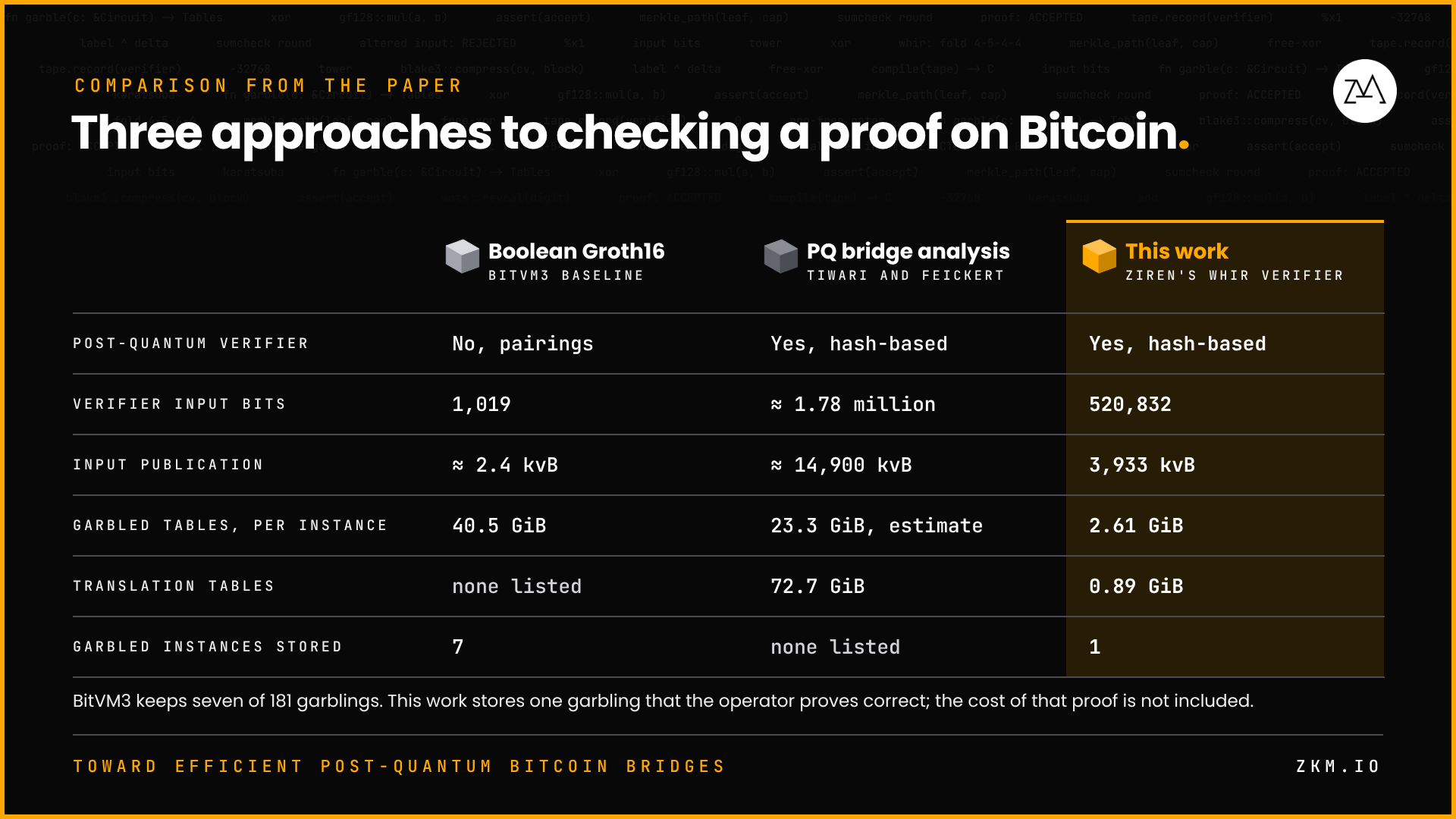
Against the Boolean-garbled Groth16 verifier used as BitVM3's baseline, the garbled tables are about 15.5 times smaller: 2.61 GiB per instance against 40.5 GiB. BitVM3 keeps seven of 181 garblings after cut-and-choose. This design stores one, which the operator proves correct, and the cost of that proof is not included. The input is about 500 times larger, and the accounted onchain data rises from about 2.5 kvB to 3,933 kvB.
The BitVM3 paper's own comparison listed a Yao-style garbled STARK verifier at about 10 GB, as an estimate. In October, Tiwari and Feickert analyzed the post-quantum cost of garbled-circuit bridges and identified the same exchange: smaller tables, larger proofs. Their combined-cost example, a RISC Zero verifier with Blake3, comes to an estimated 23.3 GiB of garbled tables and about 1.78 million input bits. The columns use different proof systems and input schemes, and their onchain estimate leaves out fixed transaction overheads that ours includes, so the table compares reported totals and nothing finer.
Native-group garbling of Groth16 and witness encryption are far smaller off-chain than any garbled STARK verifier, at megabytes per instance. All of them need a pairing SNARK.
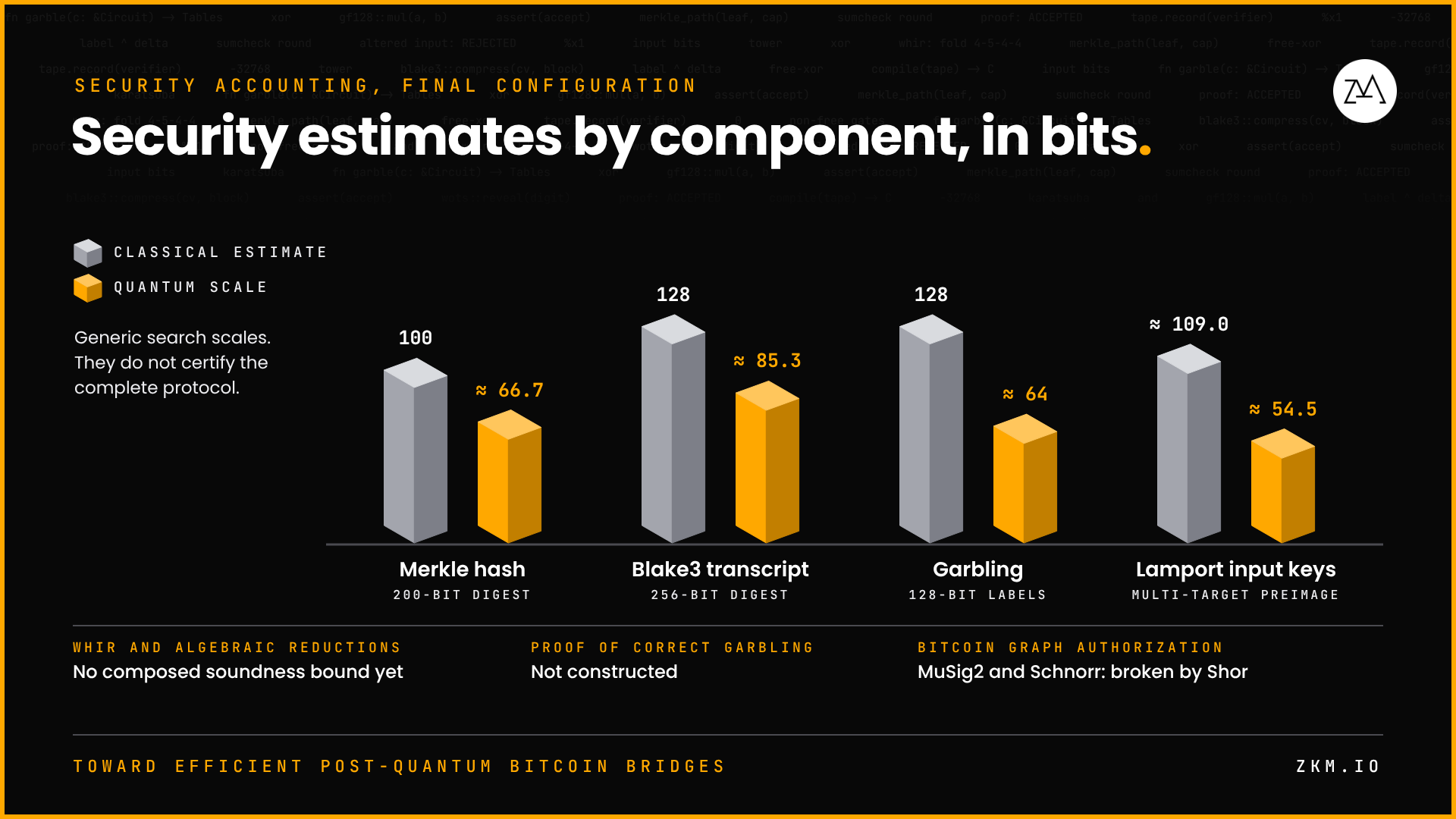
The verifier's commitments, its transcript and its garbling are hash-based. That removes the discrete-logarithm and pairing assumptions from the proof check. By the September test this is necessary for a post-quantum claim and not sufficient for one, and the paper says so. A quantum adversary still gets a generic speed-up against hashes, so each component has a quantum security level that depends on its parameters: about 66.7 bits for the 200-bit Merkle digests, about 64 bits for garbling with 128-bit labels, about 54.5 bits for Lamport input keys at this input size. The paper lists the parameter changes that would raise each one.
Three things sit outside the verifier.
The operator garbles the verifier once and has to prove that garbling correct. The proof is not constructed, so its soundness has no instantiated bound, and it has to be hash-based as well.
The Ziren proof underneath has its own assumptions. Ziren 2.0's cross-shard memory check still uses an elliptic-curve digest, and its hash-chain replacement is implemented on a branch and not yet released.
The transactions of a bridge's dispute graph are authorized with MuSig2 and Schnorr signatures, which fall to Shor's algorithm. A complete post-quantum bridge depends on a post-quantum replacement for that authorization on Bitcoin.
The paper is a measured verifier and a cost study. Two parts of the dispute protocol are not constructed.
The first is the proof of correct garbling. BABE and Mosaic check the garbler by cut-and-choose: many instances are prepared and most are opened. Here the operator garbles the verifier once and proves the garbling correct, a route the BitVM3 paper also names. That proof is not constructed, and the cost of proving the garbling of 175.4M non-free gates and the input label ciphertexts is not measured.
The second is the complete transaction graph: the challenge, timeout and fee-management branches around the publication transactions that were measured.
The paper's theorem is a statement about a correctly garbled circuit. It does not cover the proof of correct garbling or Bitcoin transaction enforcement, and the composed soundness bound for the full recursive proof is not yet instantiated.
The circuit compiler, the tower and Blake3 gadgets, a small end-to-end dispute test and the onchain serializations are in GOATNetwork/bitcoin-stark-verifier. The Blake3 circuit is contributed back to bitvm-gc. The Plonky3, Ziren and compiler revisions behind the Ethereum-block figures are not public yet.
The verifier supports any computation Ziren proves. A rollup withdrawal is one of them, which is the case a Bitcoin bridge such as GOAT Network's needs.
ZKM builds zero-knowledge proving infrastructure for verifiable computing. Its open-source general-purpose zkVM, Ziren, proves MIPS32 execution for Geth and programs in Rust, C and Go.
"Toward Efficient Post-Quantum Bitcoin Bridges" has been published on the IACR Cryptology ePrint Archive. It takes the complete verifier for the STARK proofs Ziren produces, compiles it into a Boolean circuit, and garbles it for a BitVM3-style dispute on Bitcoin. Nothing in that verifier rests on an elliptic curve or a pairing.
For the proof of Ethereum mainnet block 26,206,588, the final verifier has 175.4 million non-free gates and reads 520,832 input bits. Its garbled tables are 2.81 GB. Publishing its input on Bitcoin in a dispute takes 3.93 million virtual bytes in 41 standard transactions.
This post explains where those numbers come from, what they replace, and what the paper leaves unbuilt.
In September we set out a test for the phrase "post-quantum": every assumption in the security theorem has to hold against a quantum adversary, including the assumptions of whatever statement a hash-based layer carries. A garbled circuit is hash-based. A garbled Groth16 verifier still asserts a pairing equation, so it inherits the break.
That is where existing BitVM-style bridge designs stand. A STARK is large, so it is wrapped in a pairing-based SNARK and the SNARK's verifier is what gets garbled. Witness-encryption designs shrink the off-chain data further, to megabytes, and they are keyed to the same pairing relation.
On Ethereum, the way out is a verifier in Solidity that checks the hash-based proof directly, which The last two curves described on November 11th. On Bitcoin, a hash-based verifier written directly in Script does not fit: our September measurement put a WHIR opening alone at about 560 MB of script. The route that keeps the chain footprint to the proof itself is to garble the hash-based verifier. Garbling only requires that the verifier be a Boolean circuit. The questions are how large that circuit is and how much proof has to reach the chain.
Under free-XOR garbling, a circuit pays only for its non-linear gates. In a field of characteristic two, every addition is an XOR. A STARK over GF(2^128) with Blake3 commitments therefore costs, as a garbled circuit, its field multiplications and its hashes. Additions are free.
The paper implements Plonky3's binary tower arithmetic as Boolean gadgets with recursive Karatsuba multiplication, which gives 2,187 AND gates for a multiplication in GF(2^128). Squaring and multiplication by the tower generator use XORs only. It also rewrites the carry logic in the Blake3 circuit of GOAT's bitvm-gc, which halves a compression from 20,657 AND gates to 10,281.
The hash matters more than the proof system. A width-16 Poseidon2 permutation over KoalaBear costs 1,240,747 AND gates as a Boolean circuit, about 120 Blake3 compressions. Ziren's own proofs are committed with Poseidon2 over KoalaBear, so they are the wrong thing to garble directly. Ziren's binary stage re-proves the verifier of the compressed proof in a binary-field system, and the circuit that is finally garbled contains no KoalaBear arithmetic.
Blake3 serves three roles: the Merkle commitments, the Fiat-Shamir transcript and the garbling hash. One hash keeps the verifier's assumptions to Blake3 modeled as a random oracle with circular correlation robustness.
Ziren executes the block in 110.8 million cycles over 49 shards, proves the shards on GPU and compresses them into one proof. The binary stage proves the execution of that proof's verifier in a binary-field proof system. Four recursion proofs follow, each proving the execution of the previous proof's verifier. The first two use Ziren's plain recursion machine. The last two are narrow-recursion proofs, made in a machine with fewer trace columns, so that the final verifier has less to read.
A recorder then executes the verifier of the last proof once and writes out its straight-line program: field arithmetic and assertions, byte conversions, selections, Blake3 compressions and Merkle steps. The compiler turns that program into a Boolean circuit instruction by instruction and joins every assertion and range check into one acceptance output.
The compiled verifier was checked against the block's real final proof. It accepts that proof, rejects three single-input changes, agrees with the recorded execution on all 10,121,640 intermediate values, and garbles in 121 seconds on one core.
From block to final proof, the prover took 1,174 seconds of wall time on at most four RTX 5090 cards. Most of the last proof's time is proof-of-work grinding, which is the lever the paper uses to shorten the input.
In a BitVM3-style dispute the operator publishes the proof under one-time keys that hand the challenger the circuit's input labels. Every input bit therefore costs virtual bytes. A Groth16 proof is about a thousand bits. This verifier reads 520,832.
The paper serializes four ways of publishing that input and counts everything in the reveal transactions: selection witnesses, authentication scripts, control blocks, transaction-binding signatures and fixed fields.
Schnorr adaptor signatures, as in BitVM3 and Mosaic, are the cheapest at 2.13 vB per bit, and they rest on discrete logarithms. Of the hash-based schemes, Winternitz keys with a translation table cost 7.55 vB per bit, Antichain Winternitz 11.38 and Lamport 16.59. For this input the translated Winternitz publication is 3.93 MvB in 41 transactions that each stay inside Bitcoin Core's standard relay limits. Confirming them takes one block for funding and at least four full blocks of reveals.
An unchallenged claim publishes none of this. It needs two transactions.
The paper also serializes a hash-based selector that would match the adaptor's size if Bitcoin had a batch hash-verification opcode, a hash-based transaction signature and the draft pay-to-Merkle-root output. None of the three exists on Bitcoin today, and the paper presents the result as a measurement of what such an opcode would be worth.
Onchain cost is linear in the input bits. Off-chain storage is linear in the gate count. Proving time grows exponentially with the grinding that shortens the input. Each reduction in the paper moves cost from one of these to another, and the paper states the exchange rate each time.
The closing column sumcheck sends 126 column folds in place of 1,744 opened values. It removes 27% of the uncapped input and adds 41% more non-free gates. Embedding the upper levels of the fixed preprocessing tree as constants removes a further 40,656 input bits. Folding 4-5-4-4 in the last proof's WHIR schedule instead of 4-4-4-5 removes 3.9% of the input for 2.1 times the expected grinding. Halving the rate to 1/2048 would read 4.6% fewer bits for 4.5 times the expected grinding, and would double the first codeword.
The paper gives a formula that fixes the final verifier's input exactly from the WHIR schedule, and the expected grinding from the same parameters. It reproduces the input of every final verifier the authors compiled. Anyone choosing parameters for a different recursion trace can price a schedule before proving it.
Against the Boolean-garbled Groth16 verifier used as BitVM3's baseline, the garbled tables are about 15.5 times smaller: 2.61 GiB per instance against 40.5 GiB. BitVM3 keeps seven of 181 garblings after cut-and-choose. This design stores one, which the operator proves correct, and the cost of that proof is not included. The input is about 500 times larger, and the accounted onchain data rises from about 2.5 kvB to 3,933 kvB.
The BitVM3 paper's own comparison listed a Yao-style garbled STARK verifier at about 10 GB, as an estimate. In October, Tiwari and Feickert analyzed the post-quantum cost of garbled-circuit bridges and identified the same exchange: smaller tables, larger proofs. Their combined-cost example, a RISC Zero verifier with Blake3, comes to an estimated 23.3 GiB of garbled tables and about 1.78 million input bits. The columns use different proof systems and input schemes, and their onchain estimate leaves out fixed transaction overheads that ours includes, so the table compares reported totals and nothing finer.
Native-group garbling of Groth16 and witness encryption are far smaller off-chain than any garbled STARK verifier, at megabytes per instance. All of them need a pairing SNARK.
The verifier's commitments, its transcript and its garbling are hash-based. That removes the discrete-logarithm and pairing assumptions from the proof check. By the September test this is necessary for a post-quantum claim and not sufficient for one, and the paper says so. A quantum adversary still gets a generic speed-up against hashes, so each component has a quantum security level that depends on its parameters: about 66.7 bits for the 200-bit Merkle digests, about 64 bits for garbling with 128-bit labels, about 54.5 bits for Lamport input keys at this input size. The paper lists the parameter changes that would raise each one.
Three things sit outside the verifier.
The operator garbles the verifier once and has to prove that garbling correct. The proof is not constructed, so its soundness has no instantiated bound, and it has to be hash-based as well.
The Ziren proof underneath has its own assumptions. Ziren 2.0's cross-shard memory check still uses an elliptic-curve digest, and its hash-chain replacement is implemented on a branch and not yet released.
The transactions of a bridge's dispute graph are authorized with MuSig2 and Schnorr signatures, which fall to Shor's algorithm. A complete post-quantum bridge depends on a post-quantum replacement for that authorization on Bitcoin.
The paper is a measured verifier and a cost study. Two parts of the dispute protocol are not constructed.
The first is the proof of correct garbling. BABE and Mosaic check the garbler by cut-and-choose: many instances are prepared and most are opened. Here the operator garbles the verifier once and proves the garbling correct, a route the BitVM3 paper also names. That proof is not constructed, and the cost of proving the garbling of 175.4M non-free gates and the input label ciphertexts is not measured.
The second is the complete transaction graph: the challenge, timeout and fee-management branches around the publication transactions that were measured.
The paper's theorem is a statement about a correctly garbled circuit. It does not cover the proof of correct garbling or Bitcoin transaction enforcement, and the composed soundness bound for the full recursive proof is not yet instantiated.
The circuit compiler, the tower and Blake3 gadgets, a small end-to-end dispute test and the onchain serializations are in GOATNetwork/bitcoin-stark-verifier. The Blake3 circuit is contributed back to bitvm-gc. The Plonky3, Ziren and compiler revisions behind the Ethereum-block figures are not public yet.
The verifier supports any computation Ziren proves. A rollup withdrawal is one of them, which is the case a Bitcoin bridge such as GOAT Network's needs.
ZKM builds zero-knowledge proving infrastructure for verifiable computing. Its open-source general-purpose zkVM, Ziren, proves MIPS32 execution for Geth and programs in Rust, C and Go.


