

ZKM Research
Seventeen years into this experiment, it is worth asking the question: what is crypto actually for?
Not the usual answers given at conferences. Not "faster payments" - payments were fast before us. Not "decentralization" - decentralization is a means, not an end, and treating it as an end usually leads to systems that are decentralized but useless. Not even "trustlessness" though that word gets closest, because trustlessness as commonly used describes an absence - the removal of intermediaries - and you cannot build a civilization-scale technology out of an absence.
Rather than removing trust, Bitcoin's actual innovation was relocating it - from institutions, which can lie, to computation, which can be checked. One CPU, one vote. The genius of the design was not that nobody had to trust anybody; it was that the thing being trusted became something anyone could independently verify. The whitepaper demonstrated a machine that produces trust as an output, continuously, from electricity and mathematics.
Once you see crypto as a trust-producing machine rather than a trust-removing one, you can ask the engineering question that follows: what is the failure mode of such a machine? Where does it break?
It breaks, every single time it has ever broken, in the same place. It breaks where the machine has to make a claim about itself - or about another machine like it - and that claim is not verified.
This essay is about that failure mode, and about the property that eliminates it. We call the property verifiable reflexivity. We believe it is the most important property in this industry - more fundamental than scalability, more fundamental than interoperability, more fundamental even than decentralization, because all three turn out to be special cases of it.
George Soros used "reflexivity" to describe markets in which the participants' beliefs about reality alter the reality itself, which in turn alters the beliefs. Prices are not a passive readout of fundamentals; prices change fundamentals. A rising stock lowers a company's cost of capital, which improves its fundamentals, which justifies the rising stock. The loop is the system.
Crypto is the most reflexive financial system ever constructed - and crucially, it is reflexive in two registers at once.
Economic reflexivity. A token's price funds the security budget that protects the ledger on which the token's price is recorded. Belief in a chain attracts developers, whose applications generate fees, which justify the belief. Total value locked attracts liquidity, which deepens markets, which attracts total value locked. There is no "outside" in crypto, no exogenous fundamental to anchor against. The fundamentals are the loop.
Computational reflexivity. A blockchain is, formally, a system whose every state is a claim about its previous state. Consensus is nodes agreeing about what nodes agree about. A smart contract reads state that other contracts wrote, under rules that the state itself encodes. Rollups are chains that exist as claims inside other chains. Light clients are programs whose entire job is to evaluate a chain's assertions about itself. Self-reference is not an edge case in this architecture. Self-reference is the architecture.
Now look at the catastrophe record of this industry through that lens.
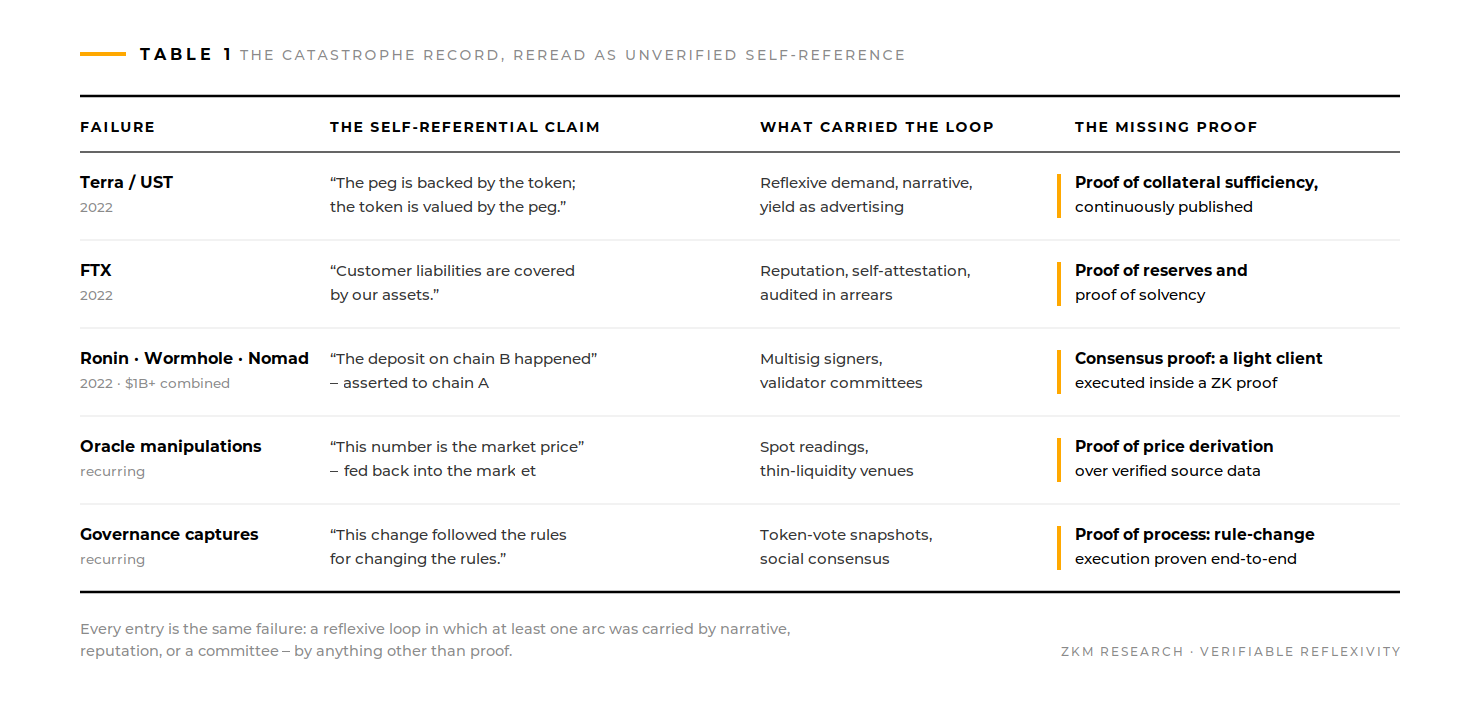
Terra was an economic reflexive loop - the peg backed by the token, the token valued by the peg - in which no link of the loop was ever proven, only narrated. FTX was an institution attesting to its own solvency, a self-referential claim verified by nobody until reality verified it the hard way. The bridge hacks - Ronin, Wormhole, Nomad, billions of dollars in aggregate - were all, without exception, one system accepting another system's claim about its own state without verification: a multisig says the deposit happened, a committee says the message is real. Oracle manipulations are reflexivity attacks: feed a protocol a claim about a price, watch the protocol's reaction move the price toward the claim. Governance attacks are loops where the rules for changing the rules were trusted rather than checked.
Every one of these is the same failure. Unverified self-reference. A reflexive loop in which at least one arc of the circle was carried by reputation, by a signature committee, by social consensus, by hope - by anything other than proof.
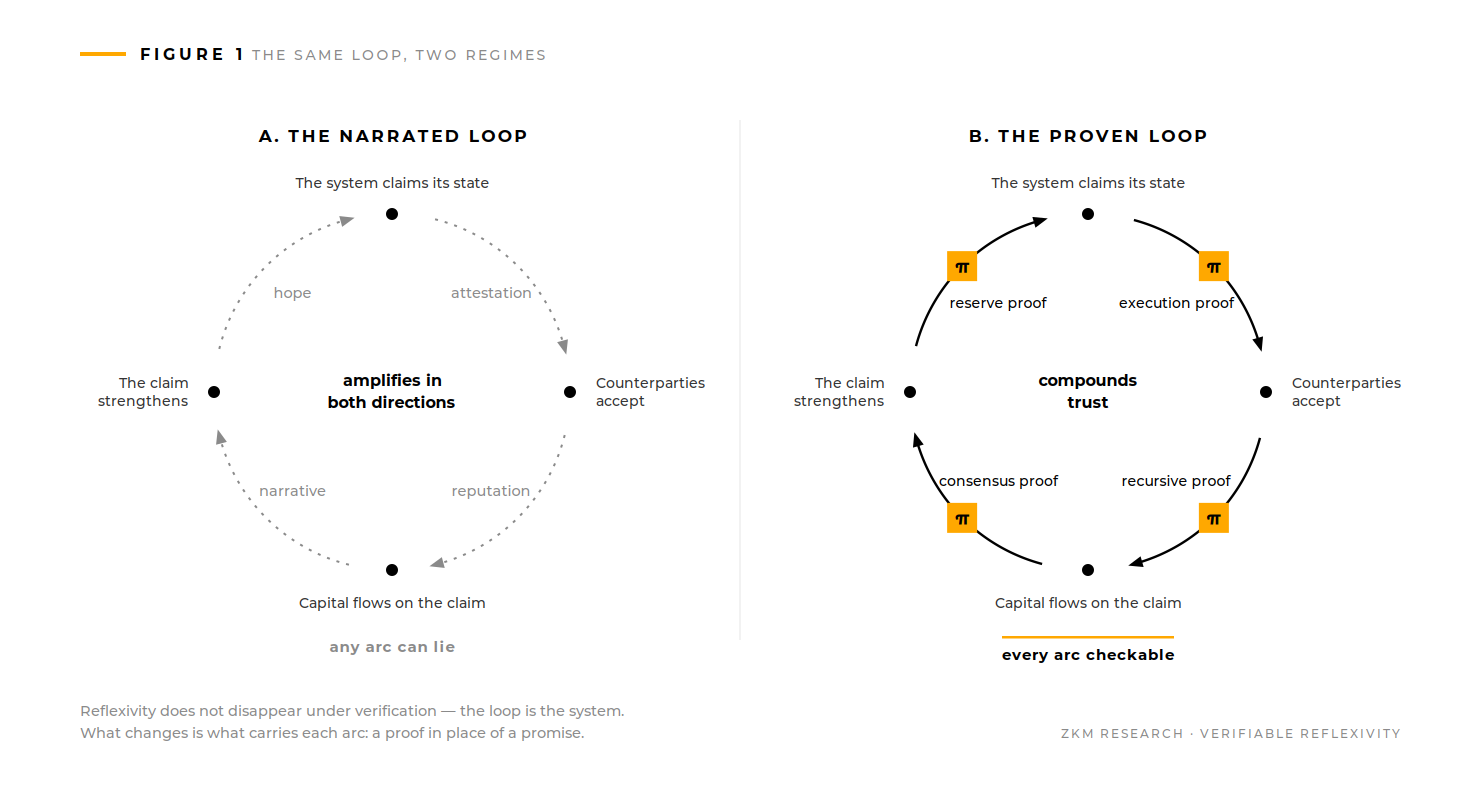
Soros's deepest observation was that reflexive systems are not self-correcting; they are self-amplifying, in both directions. A loop built on narrative inflates on narrative and collapses on narrative. This is why crypto's booms are so vertical and its failures so total.
We can now state the property precisely.
A system exhibits verifiable reflexivity when every self-referential claim it depends upon - claims it makes about its own state, its own execution, and its own rules, and claims that other systems make about it - is accompanied by a succinct proof that any party, including the system itself, can check at negligible cost.
Unpack the three clauses, because each one is a distinct engineering frontier.
First: claims about its own execution. A system should be able to prove that it did what its rules say it does. This is verifiable computing in the classical sense - the program ran, here is a receipt - and it is what a zkVM provides: take an arbitrary program, execute it, and emit a cryptographic proof of correct execution that is exponentially cheaper to check than to recompute. The trust relocation that Bitcoin achieved for one specific computation (ordering transactions) becomes available for any computation.
Second: claims about itself, including its own verification machinery. This is where reflexivity becomes literal, and where the deepest engineering lives. A proof system that can prove statements about its own verifier - a prover proving "I correctly checked this other proof" - achieves recursion. Recursion is self-reference made safe: proofs of proofs, folding unbounded computation into constant-size certificates. A chain that can produce a recursive proof of its entire history is a system that can hand you, in a few hundred bytes, a checkable claim about everything it has ever been. Gödel showed that sufficiently powerful formal systems cannot prove their own consistency. Engineering's answer is humbler and more useful: a system can prove its own execution, step by step, including the execution of its own checking - and that turns out to be enough to close the loop in practice.
Third: claims that other systems make about it. Interoperability is reflexivity at one remove - chain A holding a belief about chain B's state. Verifiable reflexivity demands that this belief arrive as a proof: a light client executed inside a proof, a consensus verification compressed into a certificate, so that chain A is not trusting a committee's description of chain B but checking chain B's mathematics directly. This is the difference between a bridge and an entanglement. A bridge is a narrated claim with a security council. Entanglement is two systems sharing verified state with no new trust assumption introduced anywhere in the loop.
And the definition deliberately reaches beyond pure computation into the economic register. Proof of reserves, done honestly, is verifiable reflexivity applied to a balance sheet: the institution's claim about itself rendered checkable. Proof of solvency, proof of policy adherence, proof that a protocol's collateral loop actually closes - these convert economic reflexivity from narrative-amplified to proof-anchored. The loop still runs. Reflexivity does not disappear; it is the nature of these systems. But a loop whose every arc carries a proof cannot quietly hollow out. It can still deflate - markets are markets - but it cannot lie about itself on the way up, which is the specific mechanism by which every great crypto catastrophe was manufactured.
A strong claim deserves a strong defense. Here is why verifiable reflexivity is not one property among many, but the property from which the others are derived.
Scalability is verifiable reflexivity. What is a rollup? A chain that executes elsewhere and proves itself to a settlement layer. The entire ZK-rollup paradigm is the discovery that a system which can succinctly prove claims about its own execution can outsource that execution anywhere - and the settlement layer's security travels with the proof. Recursion and aggregation, the techniques that make this economical, are self-reference techniques. The scaling roadmap of this entire industry is, formally, a program of making blockchains better at verified self-description.
Interoperability is verifiable reflexivity. The multichain world failed not because connecting chains is hard, but because it was attempted without this property - every bridge a committee, every committee a single point of narrative trust, every hack the same unverified self-referential claim. The interoperable world that actually works is one in which chains consume each other's proofs, not each other's promises. Native assets moving between systems with zero added trust assumptions is not a bridging problem. It is a reflexivity problem, and proofs are its only known solution.
Decentralization is downstream of it. A system whose self-claims cannot be cheaply verified must fall back on social consensus to police them - committees, foundations, trusted sequencers, "just trust the team for now". Every centralization vector in crypto is a place where verification was too expensive and a trusted party was installed as a shortcut. Make self-verification cheap enough and the shortcut loses its justification. Decentralization is not achieved by distributing trust across more parties; it is achieved by making trust in parties unnecessary. One CPU, one vote - generalized.
And the next decade demands it. We are entering a world in which the dominant economic actors on these networks will not be humans clicking wallets but autonomous agents - AI systems transacting, allocating, negotiating at machine speed. An agent is a reflexive object par excellence: a system whose behavior is a claim about its own policy. You cannot audit it by deposition. You cannot subpoena its intentions. The only viable trust architecture for an agentic economy is one in which the agent proves its execution - proves it followed its stated policy, proves its model produced its output, proves its claims about itself. An economy of unverified self-describing machines is the FTX problem at light speed. An economy of proof-carrying agents is something genuinely new in the history of cooperation.
Trustlessness was the absence. Verifiable reflexivity is the presence - the positive property that the absence was always pointing toward. A system that can prove every claim in its own loop does not merely lack trusted parties. It manufactures trust, succinctly, portably, at the speed of verification.
A property this fundamental cannot live in a whitepaper. It has to be built, and the building imposes brutal constraints that shaped every architectural decision we have made.
Verifiable reflexivity is not only a cryptographic property. It is a performance property. A loop is only as good as its latency: a proof of your state that arrives after your state has changed is a historical document, not a trust instrument. For reflexivity to be live - for systems to act on each other's proofs in real time, for agents to transact against fresh certificates, for entangled chains to share state at the speed of blocks - proving must approach the speed of execution itself. This is why we treat real-time proving not as a benchmark vanity metric but as the threshold condition for the entire thesis. Below the threshold, verifiable reflexivity is an auditing tool. Above it, it is an operating principle.
It is why we chose a fixed, battle-hardened instruction set when the fashionable path was an extensible one. Self-reference punishes ambiguity: a recursive proof system is a hall of mirrors, and any looseness in the base layer compounds at every reflection. A fixed ISA means a fixed circuit, a fixed semantics, a surface that can be audited once and trusted at every level of the recursion. The harder path at the foundation is the only path that stays standing when the foundation must hold up proofs of proofs of proofs.
It is why recursion and aggregation are not features of the system but its spine. A general-purpose zkVM - ordinary programs in, succinct proofs out - is the universal adapter for the first clause of the definition. A verifier that runs efficiently inside the VM it verifies is the second clause. Consensus verification of foreign chains executed inside proofs is the third. The architecture is the definition, compiled.
And it is why the endgame is not a faster prover but an entangled network - chains sharing native state through proofs alone, liquidity unified without a single new trust assumption, every loop in the system closed by verification. Not a bridge between islands. A single fabric whose every thread is checkable.
There is an old result in computer science - the fixed-point theorem behind quines and self-interpreters - establishing that any sufficiently expressive computational system can construct programs that operate on their own descriptions. Self-reference is not a paradox to be avoided; handled correctly, it is the most powerful tool in the discipline. Compilers compile themselves. Operating systems host their own development. The systems that endure are the ones that learned to close the loop on themselves.
Crypto is now arriving at its own fixed point. For seventeen years we have built systems defined by self-reference - economically, computationally, socially - while leaving the self-reference itself unverified, and we have paid for that gap in nine-figure increments, in collapsed pegs and hollow exchanges and drained bridges, in every cycle where narrative carried what proof should have. The lesson of the catastrophe record is that reflexivity is simply what these systems are. The lesson is that reflexivity without verification is a loaded weapon pointed inward.
Verifiable reflexivity is the disarming of it - and more than that, the inversion of it. The same loops that amplified collapse become, once every arc carries a proof, the loops that compound trust. A chain that proves itself to other chains. A rollup that proves itself to its settlement layer. An institution that proves itself to its depositors. An agent that proves itself to its counterparties. A network of systems, each one a machine for producing checkable claims about itself, each one consuming the checkable claims of the others - trust manufactured at every node, propagated at the speed of verification, with no committee, no custodian, no narrative anywhere in the circle.
That is what crypto is for. Not the absence of trust - the proof of it, recursively, all the way down and all the way around.
ZKM builds Ziren, a general-purpose zkVM for verifiable computation, and designed the Entangled Rollup Network for unified native liquidity across blockchains without added trust assumptions.
www.zkm.io
ZKM Research
Seventeen years into this experiment, it is worth asking the question: what is crypto actually for?
Not the usual answers given at conferences. Not "faster payments" - payments were fast before us. Not "decentralization" - decentralization is a means, not an end, and treating it as an end usually leads to systems that are decentralized but useless. Not even "trustlessness" though that word gets closest, because trustlessness as commonly used describes an absence - the removal of intermediaries - and you cannot build a civilization-scale technology out of an absence.
Rather than removing trust, Bitcoin's actual innovation was relocating it - from institutions, which can lie, to computation, which can be checked. One CPU, one vote. The genius of the design was not that nobody had to trust anybody; it was that the thing being trusted became something anyone could independently verify. The whitepaper demonstrated a machine that produces trust as an output, continuously, from electricity and mathematics.
Once you see crypto as a trust-producing machine rather than a trust-removing one, you can ask the engineering question that follows: what is the failure mode of such a machine? Where does it break?
It breaks, every single time it has ever broken, in the same place. It breaks where the machine has to make a claim about itself - or about another machine like it - and that claim is not verified.
This essay is about that failure mode, and about the property that eliminates it. We call the property verifiable reflexivity. We believe it is the most important property in this industry - more fundamental than scalability, more fundamental than interoperability, more fundamental even than decentralization, because all three turn out to be special cases of it.
George Soros used "reflexivity" to describe markets in which the participants' beliefs about reality alter the reality itself, which in turn alters the beliefs. Prices are not a passive readout of fundamentals; prices change fundamentals. A rising stock lowers a company's cost of capital, which improves its fundamentals, which justifies the rising stock. The loop is the system.
Crypto is the most reflexive financial system ever constructed - and crucially, it is reflexive in two registers at once.
Economic reflexivity. A token's price funds the security budget that protects the ledger on which the token's price is recorded. Belief in a chain attracts developers, whose applications generate fees, which justify the belief. Total value locked attracts liquidity, which deepens markets, which attracts total value locked. There is no "outside" in crypto, no exogenous fundamental to anchor against. The fundamentals are the loop.
Computational reflexivity. A blockchain is, formally, a system whose every state is a claim about its previous state. Consensus is nodes agreeing about what nodes agree about. A smart contract reads state that other contracts wrote, under rules that the state itself encodes. Rollups are chains that exist as claims inside other chains. Light clients are programs whose entire job is to evaluate a chain's assertions about itself. Self-reference is not an edge case in this architecture. Self-reference is the architecture.
Now look at the catastrophe record of this industry through that lens.
Terra was an economic reflexive loop - the peg backed by the token, the token valued by the peg - in which no link of the loop was ever proven, only narrated. FTX was an institution attesting to its own solvency, a self-referential claim verified by nobody until reality verified it the hard way. The bridge hacks - Ronin, Wormhole, Nomad, billions of dollars in aggregate - were all, without exception, one system accepting another system's claim about its own state without verification: a multisig says the deposit happened, a committee says the message is real. Oracle manipulations are reflexivity attacks: feed a protocol a claim about a price, watch the protocol's reaction move the price toward the claim. Governance attacks are loops where the rules for changing the rules were trusted rather than checked.
Every one of these is the same failure. Unverified self-reference. A reflexive loop in which at least one arc of the circle was carried by reputation, by a signature committee, by social consensus, by hope - by anything other than proof.
Soros's deepest observation was that reflexive systems are not self-correcting; they are self-amplifying, in both directions. A loop built on narrative inflates on narrative and collapses on narrative. This is why crypto's booms are so vertical and its failures so total.
We can now state the property precisely.
A system exhibits verifiable reflexivity when every self-referential claim it depends upon - claims it makes about its own state, its own execution, and its own rules, and claims that other systems make about it - is accompanied by a succinct proof that any party, including the system itself, can check at negligible cost.
Unpack the three clauses, because each one is a distinct engineering frontier.
First: claims about its own execution. A system should be able to prove that it did what its rules say it does. This is verifiable computing in the classical sense - the program ran, here is a receipt - and it is what a zkVM provides: take an arbitrary program, execute it, and emit a cryptographic proof of correct execution that is exponentially cheaper to check than to recompute. The trust relocation that Bitcoin achieved for one specific computation (ordering transactions) becomes available for any computation.
Second: claims about itself, including its own verification machinery. This is where reflexivity becomes literal, and where the deepest engineering lives. A proof system that can prove statements about its own verifier - a prover proving "I correctly checked this other proof" - achieves recursion. Recursion is self-reference made safe: proofs of proofs, folding unbounded computation into constant-size certificates. A chain that can produce a recursive proof of its entire history is a system that can hand you, in a few hundred bytes, a checkable claim about everything it has ever been. Gödel showed that sufficiently powerful formal systems cannot prove their own consistency. Engineering's answer is humbler and more useful: a system can prove its own execution, step by step, including the execution of its own checking - and that turns out to be enough to close the loop in practice.
Third: claims that other systems make about it. Interoperability is reflexivity at one remove - chain A holding a belief about chain B's state. Verifiable reflexivity demands that this belief arrive as a proof: a light client executed inside a proof, a consensus verification compressed into a certificate, so that chain A is not trusting a committee's description of chain B but checking chain B's mathematics directly. This is the difference between a bridge and an entanglement. A bridge is a narrated claim with a security council. Entanglement is two systems sharing verified state with no new trust assumption introduced anywhere in the loop.
And the definition deliberately reaches beyond pure computation into the economic register. Proof of reserves, done honestly, is verifiable reflexivity applied to a balance sheet: the institution's claim about itself rendered checkable. Proof of solvency, proof of policy adherence, proof that a protocol's collateral loop actually closes - these convert economic reflexivity from narrative-amplified to proof-anchored. The loop still runs. Reflexivity does not disappear; it is the nature of these systems. But a loop whose every arc carries a proof cannot quietly hollow out. It can still deflate - markets are markets - but it cannot lie about itself on the way up, which is the specific mechanism by which every great crypto catastrophe was manufactured.
A strong claim deserves a strong defense. Here is why verifiable reflexivity is not one property among many, but the property from which the others are derived.
Scalability is verifiable reflexivity. What is a rollup? A chain that executes elsewhere and proves itself to a settlement layer. The entire ZK-rollup paradigm is the discovery that a system which can succinctly prove claims about its own execution can outsource that execution anywhere - and the settlement layer's security travels with the proof. Recursion and aggregation, the techniques that make this economical, are self-reference techniques. The scaling roadmap of this entire industry is, formally, a program of making blockchains better at verified self-description.
Interoperability is verifiable reflexivity. The multichain world failed not because connecting chains is hard, but because it was attempted without this property - every bridge a committee, every committee a single point of narrative trust, every hack the same unverified self-referential claim. The interoperable world that actually works is one in which chains consume each other's proofs, not each other's promises. Native assets moving between systems with zero added trust assumptions is not a bridging problem. It is a reflexivity problem, and proofs are its only known solution.
Decentralization is downstream of it. A system whose self-claims cannot be cheaply verified must fall back on social consensus to police them - committees, foundations, trusted sequencers, "just trust the team for now". Every centralization vector in crypto is a place where verification was too expensive and a trusted party was installed as a shortcut. Make self-verification cheap enough and the shortcut loses its justification. Decentralization is not achieved by distributing trust across more parties; it is achieved by making trust in parties unnecessary. One CPU, one vote - generalized.
And the next decade demands it. We are entering a world in which the dominant economic actors on these networks will not be humans clicking wallets but autonomous agents - AI systems transacting, allocating, negotiating at machine speed. An agent is a reflexive object par excellence: a system whose behavior is a claim about its own policy. You cannot audit it by deposition. You cannot subpoena its intentions. The only viable trust architecture for an agentic economy is one in which the agent proves its execution - proves it followed its stated policy, proves its model produced its output, proves its claims about itself. An economy of unverified self-describing machines is the FTX problem at light speed. An economy of proof-carrying agents is something genuinely new in the history of cooperation.
Trustlessness was the absence. Verifiable reflexivity is the presence - the positive property that the absence was always pointing toward. A system that can prove every claim in its own loop does not merely lack trusted parties. It manufactures trust, succinctly, portably, at the speed of verification.
A property this fundamental cannot live in a whitepaper. It has to be built, and the building imposes brutal constraints that shaped every architectural decision we have made.
Verifiable reflexivity is not only a cryptographic property. It is a performance property. A loop is only as good as its latency: a proof of your state that arrives after your state has changed is a historical document, not a trust instrument. For reflexivity to be live - for systems to act on each other's proofs in real time, for agents to transact against fresh certificates, for entangled chains to share state at the speed of blocks - proving must approach the speed of execution itself. This is why we treat real-time proving not as a benchmark vanity metric but as the threshold condition for the entire thesis. Below the threshold, verifiable reflexivity is an auditing tool. Above it, it is an operating principle.
It is why we chose a fixed, battle-hardened instruction set when the fashionable path was an extensible one. Self-reference punishes ambiguity: a recursive proof system is a hall of mirrors, and any looseness in the base layer compounds at every reflection. A fixed ISA means a fixed circuit, a fixed semantics, a surface that can be audited once and trusted at every level of the recursion. The harder path at the foundation is the only path that stays standing when the foundation must hold up proofs of proofs of proofs.
It is why recursion and aggregation are not features of the system but its spine. A general-purpose zkVM - ordinary programs in, succinct proofs out - is the universal adapter for the first clause of the definition. A verifier that runs efficiently inside the VM it verifies is the second clause. Consensus verification of foreign chains executed inside proofs is the third. The architecture is the definition, compiled.
And it is why the endgame is not a faster prover but an entangled network - chains sharing native state through proofs alone, liquidity unified without a single new trust assumption, every loop in the system closed by verification. Not a bridge between islands. A single fabric whose every thread is checkable.
There is an old result in computer science - the fixed-point theorem behind quines and self-interpreters - establishing that any sufficiently expressive computational system can construct programs that operate on their own descriptions. Self-reference is not a paradox to be avoided; handled correctly, it is the most powerful tool in the discipline. Compilers compile themselves. Operating systems host their own development. The systems that endure are the ones that learned to close the loop on themselves.
Crypto is now arriving at its own fixed point. For seventeen years we have built systems defined by self-reference - economically, computationally, socially - while leaving the self-reference itself unverified, and we have paid for that gap in nine-figure increments, in collapsed pegs and hollow exchanges and drained bridges, in every cycle where narrative carried what proof should have. The lesson of the catastrophe record is that reflexivity is simply what these systems are. The lesson is that reflexivity without verification is a loaded weapon pointed inward.
Verifiable reflexivity is the disarming of it - and more than that, the inversion of it. The same loops that amplified collapse become, once every arc carries a proof, the loops that compound trust. A chain that proves itself to other chains. A rollup that proves itself to its settlement layer. An institution that proves itself to its depositors. An agent that proves itself to its counterparties. A network of systems, each one a machine for producing checkable claims about itself, each one consuming the checkable claims of the others - trust manufactured at every node, propagated at the speed of verification, with no committee, no custodian, no narrative anywhere in the circle.
That is what crypto is for. Not the absence of trust - the proof of it, recursively, all the way down and all the way around.
ZKM builds Ziren, a general-purpose zkVM for verifiable computation, and designed the Entangled Rollup Network for unified native liquidity across blockchains without added trust assumptions.
www.zkm.io


